Rohit Topiwala runs Travis Heights Wine & Spirits, family-owned since 2003, out of a building on the I-35 frontage road that his father Amrit Topiwala owns. Next door, in the same building, sits Whip In, the convenience store the Topiwala family opened in 1986 and grew into a bar and Indian kitchen before selling the business in 2017. In early 2023, word came down that TxDOT's early schematics for the I-35 widening put both buildings on the demolition list. By October of that year, TxDOT reversed course and spared them. But the win came with a catch: the highway's new footprint still swallows the sloped parking lot off the frontage road, and as of the reversal, Rohit was still negotiating with the state over what that lot was worth.
If you live in Travis Heights, you've probably noticed some version of this story playing out on your own street this year. A crew shows up, digs a trench, disappears for a few weeks, comes back. Your water pressure does something strange. A road you've driven for a decade suddenly has a detour sign on it. It's tempting to lump all of it into one vague category: "the construction." That's the wrong mental model. What's actually happening in Travis Heights right now is four separate projects, run by two different agencies, on four different timelines, for four different reasons. Understanding which is which is the only way to know what to expect on your specific block over the next year.
The Reason Your Water Pressure Has Never Been Great
If you've lived near East Oltorf Street and always assumed your low water pressure was a you problem, a bad showerhead or old plumbing, it's worth knowing that Austin Water's own documents say pressure along that corridor regularly drops below the state-required minimum of 35 pounds per square inch. That's not a household issue. It's a structural one, baked into how the neighborhood was built.
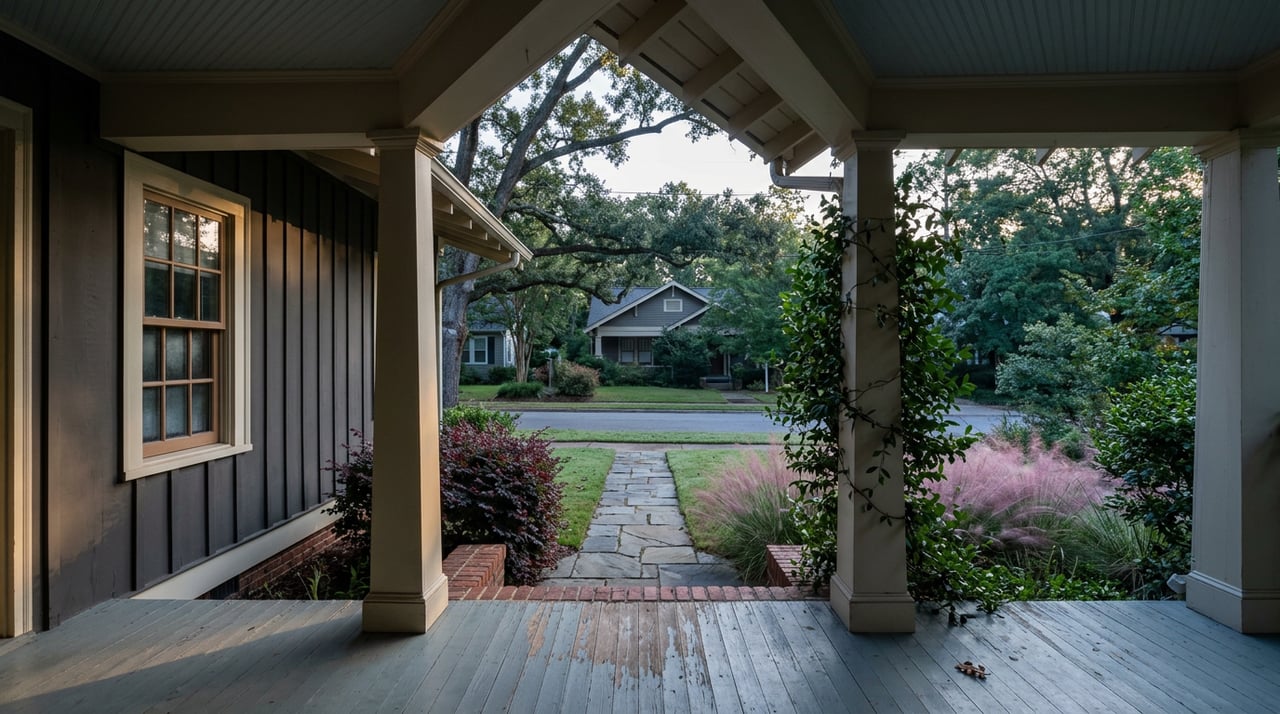
Kevin Koeller, the managing engineer on Austin Water's project, has explained that the area was developed more than a century ago, when it sat at the edge of the city. Over the decades, the hilly terrain that gives Travis Heights its character, the same bluffs that put historic bungalows forty to eighty feet above Lady Bird Lake, has meant water pressure sags noticeably in the higher elevations while lower blocks feel less of the drop.
The fix Austin Water landed on is a full pressure zone conversion. Travis Heights currently sits in the city's Central Pressure Zone. The project will move it into a new South Reduced Pressure Zone, connecting it to stronger supply. Because that jump would be too aggressive for older household plumbing, crews are installing pressure-reducing valves at key points and, where needed, free thermal expansion tanks on individual properties to prevent pressure spikes from damaging pipes or water heaters.
The project covers a defined area: roughly bounded by I-35 to the east, South Congress Avenue to the west, and St. Edward's Drive to the south, stretching north from East Oltorf to East Live Oak Street and including parts of Travis Heights Boulevard. It carries a $4.6 million price tag as one piece of Austin Water's much larger $2.8 billion capital improvement plan for the whole city's aging system.
On timing, the sourcing gets a little inconsistent, which is worth flagging rather than smoothing over. Austin Water's own project page puts construction at about 18 months once it starts this summer. When the Austin American-Statesman covered the project in December 2025, the estimate given was closer to 14 months. Either way, if you're reading this in late summer 2026, ground is either already breaking near you or about to, and the work is likely to stretch into 2027, happening in phases with rolling closures on residential streets rather than one long continuous dig.
The Pipes That Were Already Getting Ready for This
Here's the part that most residents miss, and it's the detail that actually explains why so much seems to be happening simultaneously: some of the groundwork for the pressure fix has already been laid.
The Oltorf Reclaimed Water Main Phase 2 project, which broke ground back in February 2024, is installing about 7,000 linear feet of reclaimed water pipe (the purple pipe you may have seen exposed in trenches) along Oltorf Street, Parker Lane, Mariposa Drive, and Travis Heights Boulevard. Tucked into that same scope is roughly 1,600 linear feet of larger-diameter water pipe, installed specifically to support higher water pressure down the line. That project is expected to wrap up in 2026, right around the time the pressure zone conversion is scheduled to begin.
In other words, the reclaimed water crew already ran bigger pipe through parts of the neighborhood in anticipation of the pressure project that follows it. These aren't two agencies stumbling over each other by coincidence. They're sequenced, even though each shows up on the city's books as a separate line item with its own manager and its own public meetings.
Layered on top of that is a third, newer initiative: the Travis Heights Reclaimed Water Project, which runs along a different set of streets, Fairmount Avenue, Monroe Street, and Alameda and East Side Drives, and is meant to complete a central ring connecting Austin Water's north and south reclaimed water systems. The city held a public meeting on this one at Twin Oaks Library on March 30, 2026. Construction began in early 2026 and is expected to run about 21 months, putting completion somewhere in late 2027.
Here's a quick way to keep the three water-related projects straight:
| Project | Key Streets | Purpose | Expected Timeline |
|---|---|---|---|
| Oltorf Pressure Zone Improvements | Area bounded by I-35, S. Congress, St. Edward's Dr., E. Oltorf to E. Live Oak | Move neighborhood to a higher, regulated pressure zone | Starts summer 2026, runs 14-18 months |
| Oltorf Reclaimed Water Main Phase 2 | Oltorf St, Parker Lane, Mariposa Dr, Travis Heights Blvd | Purple pipe network plus larger water mains | Began Feb 2024, expected to finish in 2026 |
| Travis Heights Reclaimed Water Project | Fairmount Ave, Monroe St, Alameda Dr, East Side Dr | Completes central reclaimed water ring | Started early 2026, runs about 21 months |
The Highway Change That Almost Erased a Neighborhood Fixture
The fourth project isn't a water project at all. It's TxDOT's $4.5 billion I-35 Capital Express Central expansion, and the Lady Bird Lake segment of that project runs the length of Travis Heights' eastern edge along the interstate, from the lake down toward Oltorf Street.
The most recent construction bulletin TxDOT has posted for this segment describes eastbound Riverside Drive reduced to one lane between the southbound I-35 frontage road and Travis Heights Boulevard, Kenwood Avenue closed at Riverside Drive, and East Avenue closed under the I-35 bridge over Lady Bird Lake, all listed as running through mid-2026. Given that we're now past that marker, those specific closures may already be resolving or shifting into their next phase. What's more durable: access to the northbound I-35 frontage road just north of Riverside is listed as closed through 2029, and TxDOT's materials note the Riverside Drive traffic pattern will keep shifting as construction continues. If you rely on this corridor, check TxDOT's My Mobility 35 project page before you plan around any specific reopening date rather than trusting a closure window that was posted months ago.
This is the same corridor project that nearly took out Whip In and Travis Heights Wine & Spirits, whose building sits on the frontage road less than half a mile north of Oltorf Street. TxDOT's early schematics had the new highway footprint running straight over the building. The agency says it refined those schematics after a review process that fielded nearly 18,000 public comments across the full eight-mile corridor, and by October 2023 the plan had shifted enough to spare the structure. The building stands, but the highway's edge now runs right up against it, and the parking lot that used to sit off the frontage road is the one being sold to the state. A second lot, accessible from Mariposa Drive, remains. It's a small case study in what "spared" actually means for a business caught inside a highway widening: you keep the building, you lose some of what made the building work.
If your daily walk or bike ride to the Lady Bird Lake trail runs anywhere near this stretch, expect detours to be part of the routine for a while. Trail and waterway closures tied to this same segment run in cycles through 2029, with some access restrictions near the I-35 bridge stretching out to 2033.
What This Actually Means Through the Rest of 2026
None of these four projects are secret. Each has a public project manager, a phone number, and a sign-up page for updates. But almost nobody in the neighborhood is tracking all four at once, which is why the whole year can feel like an undifferentiated mess of orange barrels.
A few practical things worth knowing if you live here:
- If your water pressure suddenly changes, ask whether you're in the Oltorf project boundary before assuming something is wrong with your plumbing. A pressure-reducing valve or thermal expansion tank installed by the city, at no cost to you, may be part of the plan.
- Streets like Oltorf, Parker Lane, Mariposa Drive, Travis Heights Boulevard, Fairmount Avenue, Monroe Street, and the Alameda and East Side Drives are the ones most likely to see recurring trench work between now and late 2027, not necessarily all at once, but in overlapping waves.
- If you regularly use Riverside Drive, Kenwood Avenue, or the East Avenue underpass to get to Lady Bird Lake, don't assume the old traffic pattern is back just because a posted closure date has passed. Check TxDOT's project page for the current configuration before you plan around it.
- Austin Water's project pages allow you to sign up for direct updates by street segment, which is a more reliable way to track a specific block than general neighborhood social media threads.
The bigger picture is this: Travis Heights isn't being disrupted by one problem. It's absorbing the cost of being built more than a century ago, on a hillside, right next to a highway that's now three decades into needing to grow. The infrastructure underneath the neighborhood is finally catching up to the way people actually use it today, and that catching up takes years, not weeks.
If you're trying to figure out how any of this affects a specific address, whether you're weighing a renovation timeline, wondering how a pending sale might be affected by nearby roadwork, or just want a straight answer about what's happening on your particular block, Heart of Austin knows this neighborhood block by block. Reach out and we'll walk you through exactly what's changing near you.